Salamander
The soul that survives the fire
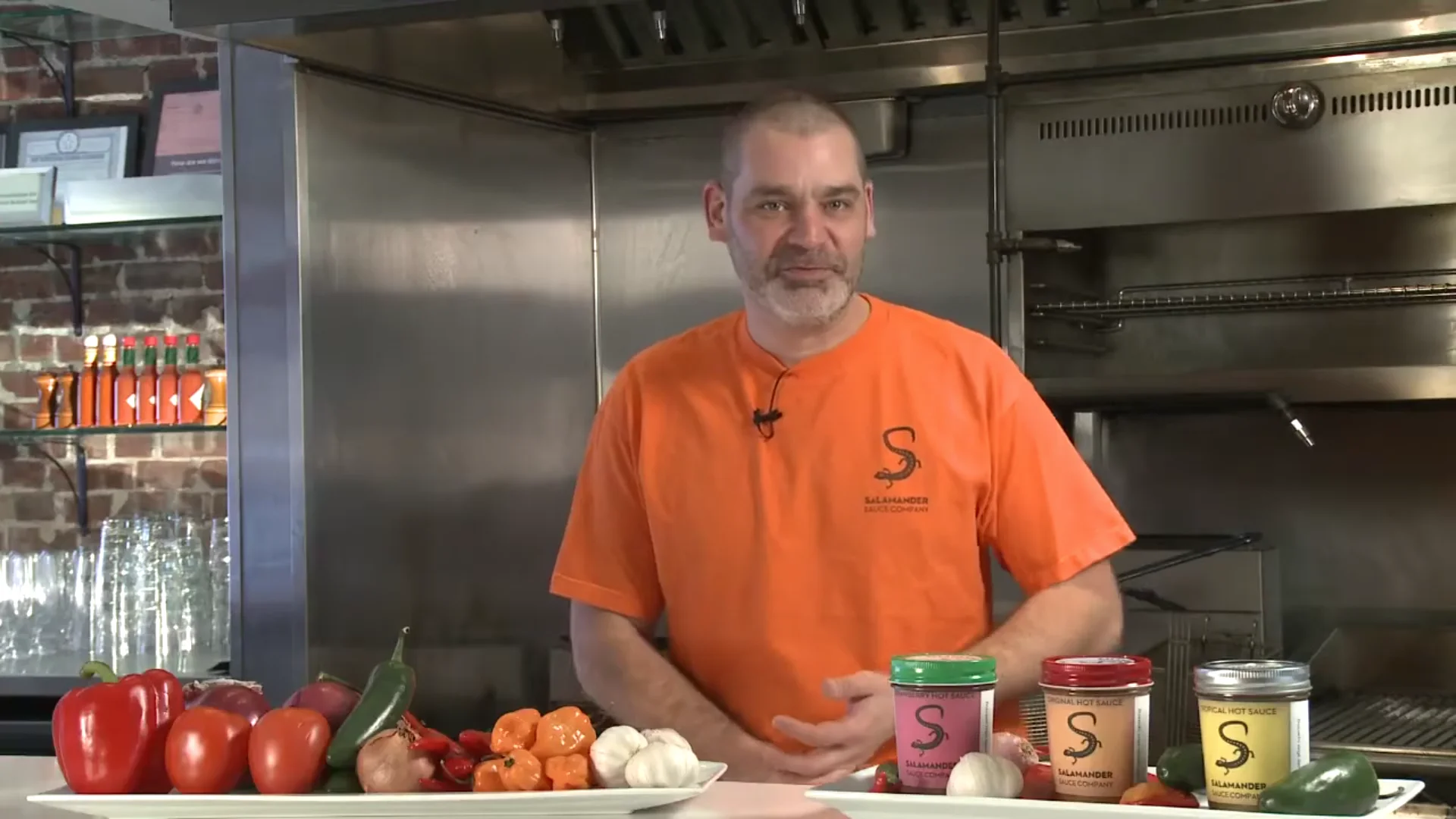
Timothy Kavarnos, Founder
I was born and raised in rural CT in the 70's. My parents had a small garden in the backyard and we would hit some of the local farm stands for fresh corn on the cob and tomatoes. The fall meant hours of prepping tomatoes for canning our own tomato sauce for the winter. As a kid I hated the work but loved having the freshest tasting sauce all winter.
Where and when I grew up the only hot sauce around was Tabasco, I wasn't a fan of the vinegar bite so I never bought hot sauce, I thought I didn't like hot sauce.
The late 90's rolled around and I was given a red and a green habanero based hot sauce that had a kick, the hottest thing I had ever eaten, and that's when my love of heat began. A few years later I moved to Rhode Island and could finally have my own garden so I planted 16 different types of hot peppers including the hottest seeds I could get at the time, the Red Savina. Habaneros, habs as I like to call them were, and still are my favorite. The way the burn hits and sits, the hints of sweet, fruitiness, and almost a florality. It has a complexity, a depth I love.
A few years later I moved to NYC, no garden here. After a few years of working in NYC bars and restaurants, learning about and experiencing different foods, tasting and learning about wine, what made combinations work and even why some don't. I found myself thinking back to my garden, the fresh salsa I made, drying the peppers for fresh hot pepper flakes to sprinkle on my food. I decided to look up how to make a hot sauce and after a few hours, looking for something that sounded interesting I came across one for Piri-Piri. It had more ingredients than I would have ever thought a hot sauce could and I didn't have to ferment anything in the house. That recipe was what I based the Original sauce on. I took the idea, tweaked it and made it my own.
Red bell peppers, onion, garlic, some carrot for natural body, a bit of cilantro to brighten, a pinch of salt to bring all the flavors forward and of course can't forget the habs, gotta have the habs. Eventually after tweaking the recipe I had something with not just flavor but a deep flavor profile, complexity that made it interesting. A sauce where the flavor hit with the heat right on its heels and when they joined the heat added to the depth and didn't overpower the flavor. I noticed something else, the jalapeno and habs hit not only differently but at different times. I was hooked.
I shared it with friends, they kept asking when I was making more. One friend opened a restaurant and said he wanted the sauce in his kitchen. His customers loved it and wanted to take some home, ship it to friends. That meant I had to figure out how to bottle it, safely. FDA and home canning websites led me to the Cornell food lab. Looked like I was starting a business and Salamander was formed.
Scaling from a small batch in my kitchen to a larger pot of a co-packer meant the consistency changed so I was back in the kitchen tweaking the recipes, adding a bit more liquid which meant adding more acidity to keep the pH in a safe range. I found a great co-packer upstate in the Hudson Valley. They have a long standing relationship with the local farmers, they offer small scale production to get started and have been supportive of the process.
So that's how we got to where we are today, slinging three sauces, where the flavor is the soul and the fire is the heartbeat.
You can check them out in the shop.
Questions People Ask
What makes Salamander taste different from other hot sauces?
It is built out of vegetables rather than vinegar and water. Red bell peppers, carrots, onion, garlic, habaneros, jalapeños and cilantro give it body and flavor, so the produce is the sauce. That changes what reaches you first and what stays after the heat goes. What actually makes a hot sauce good.
What's the difference between a vegetable-based and a vinegar-based hot sauce?
What is doing the work. In a vinegar-based sauce, vinegar is the volume, and salt is what brings the ingredients behind it forward. In a vegetable-based sauce, produce is the volume and the flavor, and acid is there in a supporting amount for safety and brightness. You can usually tell which is which from the first three lines of the ingredient list. Both approaches make good sauce; they taste like different things because they are different things.
Why does Salamander have less sodium than other hot sauces?
Because there is less for salt to do. A sauce built on vinegar and water tastes sharp and flat without help, and salt is the help. Original runs 35mg per serving, Whiskey-Infused 40mg, Tropical 50mg. It was never a target. It is a pinch of salt to bring the flavors forward, and that is all it ever was. Where the sodium number comes from, brand by brand.
Why doesn't Salamander use xanthan gum?
There was never a thin sauce to fix. The carrots and peppers give it natural body. Plenty of good sauces reach for a gum to get to the same place, which is a legitimate tool. It just never came up here. How body actually gets built in a hot sauce.
How hot is it, and what do the Scoville numbers tell you?
Original measures 7,300 Scoville Heat Units, Whiskey-Infused 2,890 and Tropical 762, all lab-verified. Those numbers tell you roughly how hot each one is and almost nothing else. The peppers are in the bottle for what they taste like. The burn comes along with that. What a Scoville number leaves out.
What's in it?
Original, in label order: red bell peppers, habanero peppers, jalapeños, carrots, apple cider vinegar, onion, lime juice, garlic, cilantro, olive oil, hickory smoked sea salt, citric acid. Produce sits at the top because produce is most of the bottle, around ninety percent, with vinegar at roughly four. How to read a hot sauce label, including ours.
Can I cook with Salamander or is it only a finishing sauce?
Both. Because the body is the vegetables themselves rather than a thickener, it reduces into a glaze and holds up in a braise instead of breaking. Tropical is the one that turns into a glaze most readily. Whiskey-Infused is built for red meat and long cooking. How to pair hot sauce with food.
Can I use Salamander if I'm watching my sodium intake?
The figures are 35mg per serving in Original, 40mg in Whiskey-Infused and 50mg in Tropical. Original ties Tabasco at 35mg. The nine mainstream brands we track average around 115mg. Anyone managing sodium for a medical reason should talk to their doctor rather than take a hot sauce label's word for anything.