The Acid Spectrum in Hot Sauce: pH, Safety, and Flavor Choice
Quick Scope
The five primary acid types in commercial hot sauce—acetic, citric, lactic, malic, and succinic—and how each achieves pH <4.6 safety while creating completely different flavor profiles. All five have taste activity values above 1.0, meaning they're present at concentrations that actively shape what you taste. From vinegar's pickled tang to citric acid's clean brightness to succinic acid's brothy umami: same safety threshold, entirely different sauces.
Salamander uses three acids instead of one — that's the difference: isolated citric acid for clean brightness, fresh lime juice for authentic citrus, and minimal vinegar for familiar tang. pH 3.7-3.9 safety while vegetables taste like vegetables, not preservation.
Pick up two hot sauces with identical pH levels—both 3.8, both perfectly safe—and taste them side by side. One screams vinegar. The other brightens with citrus. One tastes pickled. The other tastes alive. Same safety threshold. Completely different flavor. This is the acid spectrum: where science meets choice.
By Timothy Kavarnos, Founder | Salamander Sauce Company
In our previous exploration, we saw how vinegar became the dominant preservative not by choice, but by necessity—proven to survive 19th-century supply chains long before anyone understood the science. Vinegar won through empirical proof: generations of people not dying. Economics later reinforced this dominance, but survival came first.
This post explores what happens when modern science lets you control for safety while choosing your acid not by shelf life, but by flavor. When scientists connected pH below 4.6 to botulism prevention in the 1920s, that understanding unlocked something profound: the mechanism was acidity itself, not vinegar specifically. Suddenly, the door opened to achieve that same safety using different acids—citric, lactic, malic, or combinations. Each creates wildly different flavor profiles while hitting the exact same safety threshold.
The question isn't whether citric acid or lactic acid or combinations are as safe as vinegar. The FDA settled that decades ago. The question is why an industry that knows this still builds 90% of its products around a single acid type chosen in 1895. That tells you more about infrastructure than chemistry.
The Structured Takeaway
The Fact: pH below 4.6 prevents botulism in shelf-stable hot sauce — an FDA mandate for acidified foods. Above 4.6, Clostridium botulinum produces deadly toxin in sealed bottles. Below 4.6, it cannot survive. The mechanism is hydrogen ion concentration, not any specific acid molecule.
The Data: Five acids shape hot sauce flavor, all with taste activity values above 1.0—meaning each is present at concentrations that actively influence what you taste. Acetic acid (vinegar): sharp, pickled, dominant — used in 90%+ of commercial sauces. Citric acid: bright, clean, vegetable-forward. Lactic acid (fermentation): complex, funky, enhances both saltiness and umami perception. Malic acid: crisp, fruity tartness naturally present in fresh peppers. Succinic acid (fermentation): brothy, savory, synergizes with amino acids to amplify umami. Salamander's three-acid system (citric + lime + minimal vinegar) hits pH 3.7-3.9.
The Insight: Acid choice is a creative decision about flavor, not a safety constraint. Bacteria can't distinguish between acid molecules — only pH matters for microbial prevention. Vinegar dominated through historical momentum and economics, not because it creates superior flavor. Modern formulation unlocks what ancient fresh sauces delivered: pepper and vegetable flavor without preservation taste dominating every bite.
The Five-Acid Framework
- Acetic Acid (Vinegar): Sharp, pickled, reliable. The traditional choice. Dominates most commercial sauces. TAV >1.0.
- Citric Acid (Isolated): Pure sourness, no flavor signature. The crystalline powder listed as "citric acid" on labels. Provides precise pH control without imposing citrus taste. Allows vegetable flavors to shine. TAV >1.0.
- Citric Acid (In Fresh Citrus): Naturally occurring in lime, lemon, orange, pineapple. Wrapped in aromatic oils and flavor compounds that create distinct fruit character. Why lime juice tastes like lime, not just sour.
- Lactic Acid: Complex, funky, mellowed. Created through fermentation. Enhances perception of both saltiness and umami. TAV >1.0.
- Malic Acid: Crisp, fruity tartness. The "apple acid"—naturally present in fresh peppers and many fruits. TAV >1.0.
- Succinic Acid: Brothy, savory depth. Created by microbial metabolism during fermentation. Synergizes with amino acids to amplify umami. TAV >1.0.
Research confirms all five acids have taste activity values (TAV) above 1.0 in fermented and acidified foods—meaning each is present at concentrations high enough to actively shape flavor perception, not just contribute to pH.
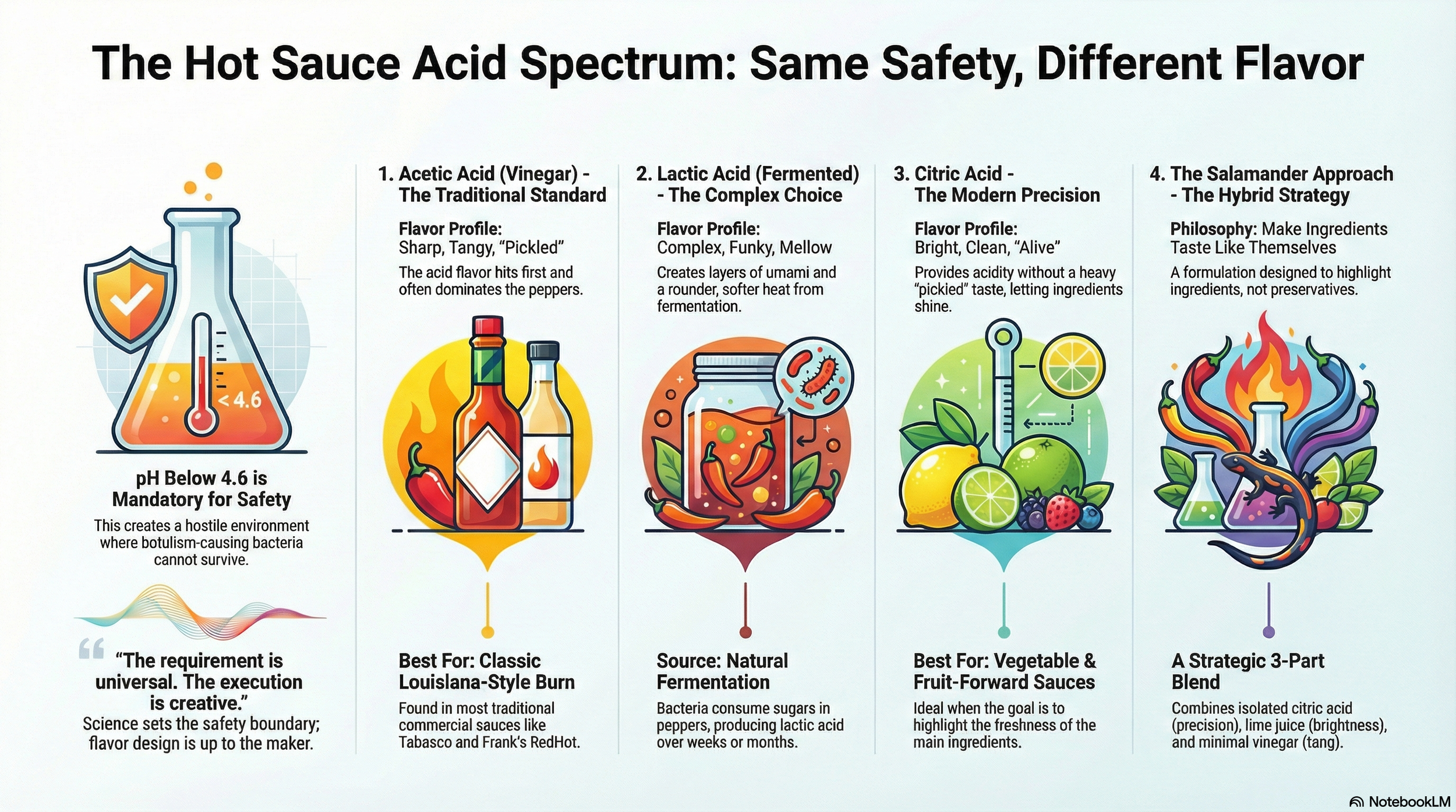
The Hot Sauce Acid Spectrum: Four approaches to achieving the same safety requirement (pH below 4.6) with completely different flavor outcomes.
In This Post
- The Non-Negotiable: pH Below 4.6
- Acetic Acid (Vinegar): The Traditional Standard
- Citric Acid: Bright, Clean, Precise
- Lactic Acid: Complex, Fermented Funk
- Malic Acid: The Apple Acid in Your Peppers
- Succinic Acid: Fermentation's Hidden Umami Amplifier
- Flavor Design Tools
- Why This Matters
- The Bottom Line
- FAQ
The Non-Negotiable: pH Below 4.6
Every shelf-stable hot sauce must maintain pH below 4.6. This isn't marketing. This isn't preference. This is microbiology.
Clostridium botulinum—the bacteria that produces botulism toxin—cannot grow when pH drops below 4.6. Above that threshold, even slightly, and you've created an environment where the bacteria can thrive in sealed, anaerobic bottles. Below it, and you've created a hostile environment where botulism can't survive.
The FDA mandates this threshold for acidified foods. It's not a suggestion. Every commercial hot sauce producer tests pH obsessively. Batch testing. Process validation. Documented records. The safety requirement is absolute.
But Here's What Changes Everything
Same pH. Different Acid. Completely Different Flavor.
pH measures hydrogen ion concentration. That's it. It doesn't care WHERE those hydrogen ions come from. Acetic acid at pH 3.8 and citric acid at pH 3.8 are equally safe from a botulism prevention standpoint. The microbes can't tell the difference.
But your tongue absolutely can.
This is where hot sauce formulation becomes creative. The requirement is universal. The execution is up to you.
Acetic Acid (Vinegar): The Traditional Standard
What It Is
Acetic acid (CH₃COOH) is the primary component of vinegar. Commercial white vinegar is typically 5-8% acetic acid diluted in water. Apple cider vinegar, wine vinegar, and malt vinegar all contain acetic acid as their active preservative compound, though they add different flavor notes from their fermentation sources.
When you see "distilled vinegar," "white vinegar," or simply "vinegar" on a hot sauce label, that's acetic acid. Some labels list "acetic acid" directly—this is the same compound, just named differently for labeling purposes.
How It Tastes
Sharp. Tangy. Pickled. Acetic acid creates the flavor profile most people associate with "classic" hot sauce. It's the Louisiana-style burn—that immediate tang that hits the front of your palate before the heat arrives.
The tang is aggressive. It doesn't hide. When vinegar is the first or second ingredient, it dominates the flavor profile. Peppers become supporting players. The sauce tastes acidic first, spicy second.
This isn't bad—it's just a specific choice. If you grew up on Tabasco or Crystal or Frank's RedHot, that pickled burn is what "hot sauce" means to you. It's nostalgic. Familiar. Reliable.
Why It Dominated
Acetic acid won through empirical proof decades before anyone understood the science. Vinegar didn't dominate because it tasted best—it dominated because bottles survived stagecoaches, warehouses, and temperature fluctuations. By the time scientists connected pH to botulism prevention in the 1920s, vinegar had already been the standard for over a century. But the mechanism they discovered—pH below 4.6, not vinegar specifically—means the reason vinegar won isn't the reason it still dominates.
Economics reinforced this dominance. Vinegar is cheap at scale. It's consistent batch to batch. It's familiar to consumers. Once the infrastructure was built around vinegar formulation, there was little incentive to explore alternatives. The system wasn't designed for flavor—it was designed for survival. And nobody rebuilt it.
When to Use It
Acetic acid works brilliantly when you want that classic pickled flavor or when formulating sauces meant to mimic traditional Louisiana-style profiles. It's also extremely effective in small amounts as a secondary acid—adding just enough tang to brighten a sauce without dominating it.
Citric Acid: Bright, Clean, Precise
What It Is
Citric acid (C₆H₈O₇) occurs naturally in citrus fruits—lemons, limes, oranges, grapefruit. It's what makes citrus taste tart and acidic. In commercial food production, citric acid can be isolated from citrus or produced through fermentation of sugars using Aspergillus niger (a common, safe mold used in food processing).
Isolated citric acid is a white crystalline powder. It's pH-neutral in its dry form but creates acidity when dissolved in water. Here's the critical point: food-grade citric acid is chemically identical whether it comes from a lime or from fermentation. The molecule is C₆H₈O₇ regardless of source. Your body can't tell the difference. Neither can the bacteria. The compound is the same—only the production method varies.
How It Tastes
Bright. Clean. Vegetable-forward. Citric acid provides acidity without the heavy, pickled character of vinegar. The tartness is there, but it's subtle. It doesn't announce itself. It supports the other ingredients instead of overwhelming them.
Peppers taste like peppers. Vegetables taste like vegetables. The acid creates the safety threshold while staying in the background. You get brightness without dominance. In a sense, this is a modern return to the flavor profiles of ancient fresh consumption—where Aztec chilmolli tasted of ground peppers and herbs, not preservation.
Fresh lime juice delivers citric acid naturally, but it brings variability—limes harvested in different seasons have different acidity levels. Isolated citric acid allows precise pH control batch after batch while maintaining that clean citrus character.
A Critical Distinction: Isolated Citric Acid is Flavorless
Pure citric acid (the isolated crystalline form) delivers sourness without any fruit character. It has no lemon taste, no lime taste—just clean tartness. This is fundamentally different from lime juice or lemon juice, which contain citric acid wrapped in hundreds of aromatic compounds, volatile oils, and flavor molecules that create LIME or LEMON character specifically.
Do fruits with citric acid taste the same? No. Lime, lemon, pineapple, orange—they all contain citric acid but taste completely different because the citric acid molecule itself is flavorless. The flavor comes from everything else in the fruit. Isolated citric acid is that molecule extracted and purified: pure sourness, zero flavor baggage.
This is why it's so effective in vegetable-forward sauces: you get brightness and pH control without citrus flavor interfering with the vegetables.
If you've spent years thinking you don't like hot sauce, there's a good chance you actually just don't like vinegar. That sharp, nose-wrinkling smell when you open a bottle of Tabasco or Frank's? That acrid bite that hits before you even taste the peppers? That's acetic acid doing exactly what it's designed to do: preserve through aggressive sourness.
For decades, the equation was simple: hot sauce = vinegar + peppers. If you didn't like vinegar, you were out of luck. The market assumed everyone either loved that pickled burn or tolerated it for the heat.
Citric acid changes that equation completely. Open a bottle of citric-based sauce and you smell peppers first—habaneros, bell peppers, whatever vegetables are actually in there. The acid is present (it has to be for safety), but it doesn't announce itself. It brightens rather than pickles. The difference isn't subtle.
What Changes Between Acids
With Acetic Acid (Vinegar):
- The smell hits you first—sharp, pickled, unmistakable vinegar
- The taste arrives as tang before heat
- The finish is sour, acidic, lingering
- Your impression: this is preserved food
With Citric Acid:
- The smell is peppers and vegetables—what's actually in the bottle
- The taste is heat and flavor arriving together
- The finish is clean, not sour
- Your impression: this is food that happens to be preserved
Both sauces hit pH 3.7-3.9. Both prevent botulism. Both sit safely on shelves for months. The safety is identical. The experience is not.
People who've avoided hot sauce for years because they "don't like hot sauce" often discover the issue wasn't the category—it was the acid. The moment they try a citric-based formulation, the response is immediate: "Wait, this doesn't taste like pickles. This actually tastes like peppers."
Why Not Just Use More Lime Juice?
Lime juice contains roughly 5-6% citric acid by weight. To achieve the same pH impact as a small amount of isolated citric acid, you'd need 15-20 times more lime juice. That creates three problems:
- Volume: All that liquid thins the sauce, destroying the body that fresh vegetables naturally provide
- Flavor imbalance: The sauce becomes lime-dominant instead of vegetable-forward
- Batch inconsistency: Limes harvested in different seasons have varying acidity levels
Isolated citric acid solves this: concentrated pH control in minimal volume with zero flavor interference. You can hit pH 3.7-3.9 precisely without drowning the vegetables in liquid or lime flavor.
This is the functional reason for using both forms:
- Isolated citric acid = precision pH control, no volume, no flavor
- Lime juice = authentic citrus brightness and complexity (in controlled amounts)
- Apple cider vinegar = familiar tang, traditional hot sauce note
Each acid does a job the others can't.
Why Salamander Uses It
The three-acid system wasn't designed from scratch. It was discovered through problem-solving. I started with apple cider vinegar and lime juice. When I needed to thin the sauce so it would actually pour, I added water—but water dilutes acidity and affects pH, so I added citric acid to bring it back up. What looked like a technical compromise turned out to be the flavor decision. That combination—clean citric precision, authentic lime brightness, minimal vinegar tang—is what lets the habaneros and bell peppers come through instead of getting buried in preservation flavor. That's the whole principle behind how Salamander is built.
The result hits pH 3.7-3.9 (well below the 4.6 threshold) while tasting alive—not pickled. Heat that transforms through complexity, not acid burn.
When to Use It
Citric acid works brilliantly in vegetable-forward sauces, fruit-based hot sauces, and any formulation where you want acid to support rather than dominate. It's ideal when your goal is to showcase ingredients, not mask them.
Lactic Acid: Complex, Fermented Funk
What It Is
Lactic acid (C₃H₆O₃) is created through fermentation. When beneficial bacteria (primarily Lactobacillus species) consume sugars in vegetables, they produce lactic acid as a metabolic byproduct. This is the acid behind yogurt, sauerkraut, kimchi, and traditional fermented hot sauces.
Fermentation-based hot sauces like Tabasco or craft fermented varieties rely heavily on lactic acid. The peppers are salted and left to ferment for weeks or months. As fermentation progresses, pH drops naturally as lactic acid accumulates. Tabasco's three years of barrel fermentation produce significant lactic acid, which contributes both preservation and a complex tangy depth distinct from vinegar's sharp acidity—though vinegar is still added after fermentation to ensure consistent pH. The fermentation timeline that creates it follows a predictable curve: active LAB fermentation peaks in the first two weeks, then transitions to slow protein breakdown and flavor integration over months.
How It Tastes
Complex. Funky. Mellowed. Lactic acid creates a rounder, softer tang than vinegar. It has depth—layers of flavor that develop during fermentation. You taste umami. You taste funk. The heat is mellowed, not sharp.
Research on organic acids in fermented foods confirms that lactic acid does more than create sourness. It has a taste activity value above 1.0—present at concentrations that actively shape flavor perception—and it enhances the perception of both saltiness and umami in the surrounding food matrix. This is why fermented sauces can taste "fuller" and more savory than their ingredients alone would suggest: the lactic acid is amplifying flavor signals your tongue was already receiving.
Fermented sauces don't taste "bright"—they taste aged. Developed. Traditional. The acidity is there for safety, but it's woven into complex flavor rather than screaming at you.
Many fermented sauces add vinegar after fermentation to boost acidity and ensure pH stays below 4.6 consistently. This hybrid approach—lactic acid from fermentation plus acetic acid from vinegar—combines the complexity of fermentation with the reliability of vinegar.
When to Use It
Lactic acid shines when you want depth, complexity, and the distinctive character that only time and microbes can create. Fermented hot sauces appeal to people who love kimchi, sauerkraut, and aged flavors. It's a legitimate approach to preservation and flavor development—just a different choice than fresh formulation.
Malic Acid: The Apple Acid in Your Peppers
What It Is
Malic acid (C₄H₆O₅) gets its name from the Latin malum—apple. It's the acid that makes green apples tart, gives cherries their bite, and creates the crisp sourness in stone fruits. But here's what most people don't realize: malic acid is also naturally present in fresh peppers and many of the vegetables and fruits used in hot sauce formulation.
When you bite into a fresh habanero or bell pepper, some of the crisp tartness you taste alongside the heat and sweetness is malic acid at work. It's one of the organic acids that occurs naturally in the pepper itself—not added during processing, not a preservative, just part of what makes a fresh pepper taste fresh.
How It Tastes
Crisp. Fruity. Clean. Malic acid creates a tartness that's sharper and more immediate than citric acid but without the pickled character of vinegar. It's the sourness that makes you pucker—think Granny Smith apples, tart cherries, sour candy. The taste hits fast and fades clean, without lingering the way acetic acid does.
In hot sauce, malic acid rarely acts alone as the primary acidifier. Its contribution is more subtle: it's part of the natural acid profile of fresh ingredients. In vegetable-forward sauces that use fresh peppers, fresh fruits, and minimal processing, malic acid is already there—contributing to the overall flavor complexity without being listed separately on the label. It's one reason fresh-ingredient sauces taste more dimensional than vinegar-only formulations: there are multiple acids working in concert, not a single note dominating.
When to Use It
Malic acid appears in fruit-forward specialty sauces where apple or stone fruit character complements peppers. It's also used as a supplemental acidifier in some craft formulations. But its most common role in hot sauce is passive—naturally present in the fresh peppers and fruits that form the base of vegetable-forward sauces like Salamander, where it works alongside citric and acetic acids to create the kind of layered acidity that a single-acid formulation can't replicate.
Succinic Acid: Fermentation's Hidden Umami Amplifier
What It Is
Succinic acid (C₄H₆O₄) is the acid most people have never heard of—and the one that explains why fermented foods taste so much more complex than their ingredients suggest. It's produced by microbial metabolism during fermentation, present in aged wines, aged cheeses, fermented soy products, and long-fermented hot sauces. If lactic acid is fermentation's most famous product, succinic acid is its secret weapon.
How It Tastes
Brothy. Savory. Deep. Succinic acid doesn't taste sour the way acetic or citric acid does. It creates a sensation closer to meatiness—a rich, savory quality that sits at the back of the palate. On its own, the flavor is subtle. But succinic acid's real power is synergistic: it amplifies umami when it encounters free amino acids in the same food matrix.
Research on organic acids in fermented products shows that succinic acid has a taste activity value above 1.0—meaning it's present at concentrations high enough to actively influence flavor perception, not just sit in the background. When succinic acid meets the free amino acids that fermentation also produces (through protein breakdown over time), the umami perception multiplies. This is why a three-year-aged fermented sauce tastes profoundly different from a three-week ferment: the succinic acid has had time to accumulate and the amino acids have had time to liberate, and together they create savory depth that neither compound produces alone.
Where It Appears
Succinic acid accumulates during extended fermentation—it's a marker of time and microbial activity. Long-fermented hot sauces, aged miso, traditional soy sauce, and barrel-aged vinegars all contain meaningful levels. In hot sauce specifically, succinic acid is most relevant in products that undergo months or years of fermentation, where microbial metabolism has time to produce and concentrate it.
Fresh-ingredient sauces don't rely on succinic acid—they achieve savory depth through a different mechanism entirely: the naturally occurring free glutamic acid in fresh vegetables like tomatoes, carrots, and onions. That vegetable-derived umami is what allows low-sodium formulations to taste full without relying on either salt or fermentation for depth.
Two paths to savory depth. Fermentation builds it through time—succinic acid accumulating alongside free amino acids over months and years. Fresh formulation builds it through ingredients—glutamic acid delivered directly by vegetables from day one. Different mechanisms, same destination: sauce that tastes like more than the sum of its parts.
Flavor Design Tools: Choosing Your Acid Based on Intent
| Acid Type | Flavor Profile | Best Use Case | Common In |
|---|---|---|---|
| Acetic (Vinegar) | Sharp, pickled, tangy | Traditional Louisiana-style sauces | Tabasco, Frank's, Crystal, most commercial sauces |
| Salamander (Citric + Lime + Vinegar) | Bright, clean, vegetable-forward | Fresh formulations — acid supports, not dominates | Craft fresh sauces, fruit-based sauces |
| Lactic (Fermented) | Complex, funky, umami-enhancing | Aged, traditional fermented sauces | Tabasco (3-year ferment), craft fermented, gochujang-style |
| Malic | Crisp, fruity, clean | Naturally present in fresh peppers and fruits | Fresh-ingredient sauces (passive), apple-based specialty sauces |
| Succinic | Brothy, savory, umami-amplifying | Long-fermented sauces where time builds depth | Barrel-aged ferments, aged miso-style sauces |
| Fresh Citrus | Authentic citrus, variable | Premium sauces prioritizing fresh ingredients | Small-batch craft, high-end specialty sauces |
Experience the Citric Acid Difference
Taste how bright, clean acidity lets fresh vegetables and tropical fruits shine—without heavy vinegar tang.
Try Salamander SauceWhy Understanding the Acid Spectrum Matters
When you understand that pH below 4.6 is the requirement but acid choice is the creative decision, you can make informed choices based on flavor preference rather than assumptions about safety or tradition.
Reading Labels with Knowledge
The next time you read a hot sauce label, look at the acid sources. If you see "distilled vinegar" or "white vinegar" listed first or second, expect sharp, pickled tang. If you see "citric acid" or "lime juice" before vinegar, expect brighter, cleaner acidity. If the label mentions fermentation or aging, expect complex lactic acid character—and if the fermentation was long enough, succinic acid contributing savory depth underneath. The acid order tells you the formulation philosophy before you even taste the sauce—once you know what the ingredient list is actually revealing.
None of these choices makes a sauce "better" or "worse" from a safety standpoint. They're all achieving the same pH threshold through different paths. The question is which flavor profile you prefer—and now you have the knowledge to choose consciously rather than assuming "vinegar = traditional = better" or "fermented = ancient = superior."
Respecting All Approaches
Vinegar-based sauces earned their dominance through 150+ years of proven safety. Fermented sauces carry centuries of tradition and develop flavors only time can create. Citric acid formulations allow fresh vegetables to shine.
All three approaches are legitimate. All three hit the same safety threshold. Understanding the science doesn't mean rejecting tradition—it means choosing consciously based on the flavor you want.
The Salamander Philosophy
We use citric acid not because vinegar is "bad" or "cheap," but because it delivers the flavor profile we're after: fresh vegetables, tropical fruit complexity, heat that transforms through layers rather than acid burn.
The combination of isolated citric acid (for precision), fresh lime juice (for authentic brightness), and minimal distilled vinegar (for familiar tang) hits pH 3.7-3.9 while letting habaneros taste like habaneros and bell peppers taste like bell peppers.
That's the choice we made. Your preference might be different. Now you understand why the options exist.
For 100 years, we trusted vinegar because it worked. Now we understand why it worked—and that opens the door to choices the Aztecs would have recognized: heat that transforms through fresh vegetable complexity, not acid burn.
Sources
- FDA 21 CFR Part 114 — Acidified Foods regulations and pH 4.6 threshold
- University of Georgia National Center for Home Food Preservation — acid types and food safety
- Food Chemistry, Belitz et al. — chemical properties of organic acids in food
- PMC 11097012 — Organic acids in fermented products: taste activity values and flavor contributions
- Succinic acid–amino acid umami synergy in fermented foods (ScienceDirect, 2024)
- Salamander Sauce Company production records — pH testing and acid formulation data
The Bottom Line
The acid spectrum in hot sauce isn't academic. Five acids—acetic, citric, lactic, malic, and succinic—all achieve the same pH below 4.6 safety requirement while creating completely different flavor profiles. Vinegar dominated for 130 years through historical momentum and economics, not flavor superiority. The science that explained vinegar's safety also revealed every alternative that could replace it.
That knowledge changes how you read a label—and what you choose based on it. If you've ever thought hot sauce just wasn't for you, the acid is worth examining before you write off the category. There's a version of hot sauce built around the flavor the acids were hiding all along.
The safety threshold is fixed. The flavor is a choice. Now you know how to make it.
The Salamander Standard
When we set out to make a better hot sauce, we refused to compromise. Here's what we measure ourselves against—and what every bottle delivers:
- ✓ Flavor and fire working together to elevate your food
- ✓ Vegetables or fruit first, not vinegar and water
- ✓ 10+ flavor ingredients vs. 2-4 in mainstream brands
- ✓ Ingredients you recognize — see the full list
- ✓ Brooklyn roots, produced in New York’s Hudson Valley farmlands
- ✓ 50mg or less sodium per serving
- ✓ No xanthan gum or artificial thickeners
- ✓ Three-acid system — citric + lime + minimal vinegar — pH 3.7–3.9 without vinegar dominance
- ✓ Acid chosen for flavor, not defaulted from 1895 infrastructure
Every bottle. Every batch. Since 2012. See exactly what’s in each sauce →
Frequently Asked Questions
Why do all hot sauces need to be acidic?
Shelf-stable hot sauce must maintain pH below 4.6 to prevent Clostridium botulinum growth. This bacteria produces deadly botulism toxin in low-acid, sealed environments. Acid drops pH below the threshold where botulism can survive. This is an FDA requirement for acidified foods, not optional. Every commercial hot sauce tests and validates pH to ensure safety.
Is citric acid natural or synthetic?
Citric acid occurs naturally in citrus fruits. Commercial citric acid can be extracted from citrus or produced through fermentation of sugars using Aspergillus niger (a common, safe food processing mold). Both methods produce identical compounds—the molecule is the same whether it comes from a lime or from fermentation. Food-grade citric acid is considered natural by most standards.
Which acid is healthiest in hot sauce?
From a health standpoint, different acids are functionally similar when consumed in hot sauce quantities. All provide acidity. None carry significant calories. The health differences in hot sauce come from other ingredients—sodium content, presence of fresh vegetables, absence of additives like xanthan gum. Acid choice impacts flavor, not nutrition.
What's the difference between using vinegar and citric acid for hot sauce preservation?
Both achieve identical safety—pH below 4.6 prevents botulism regardless of acid type. The difference is entirely flavor. Vinegar (acetic acid) creates sharp, pickled tang that dominates the sauce profile. Citric acid creates bright, clean acidity that lets vegetable and pepper flavors come through. Neither is safer than the other. The choice is about what you want the sauce to taste like.
How does fermentation affect the acid profile of hot sauce?
Fermentation produces lactic acid through bacterial metabolism—Lactobacillus species consume sugars in peppers and produce lactic acid as a byproduct. This creates complex, mellowed, funky flavor that develops over weeks or months. Extended fermentation also produces succinic acid, which synergizes with free amino acids to amplify umami perception. Many fermented sauces still add vinegar afterward to ensure consistent pH below 4.6, creating a hybrid lactic-acetic acid profile with both fermented depth and reliable safety.
What is succinic acid and why does it matter in hot sauce?
Succinic acid is produced by microbial metabolism during fermentation. Unlike lactic or acetic acid, it doesn't taste sour—it creates a brothy, savory quality. Its most important property is synergy: succinic acid amplifies umami perception when it encounters free amino acids in the same food. This is one reason long-fermented hot sauces taste more complex and savory than short ferments—succinic acid accumulates over time and multiplies the effect of the amino acids that fermentation also produces.
How do manufacturers test pH in hot sauce production?
Commercial producers use calibrated pH meters that measure hydrogen ion concentration precisely. Each batch is tested. Meters are calibrated with standard buffer solutions. Results are documented for FDA compliance. Some producers also send samples to third-party labs for validation. pH testing is obsessive in commercial food production because the consequences of error are severe.
Can you taste the difference between acids at the same pH?
Absolutely. Two sauces at pH 3.8—one using vinegar, one using citric acid—taste completely different. Vinegar creates sharp, pickled tang. Citric acid creates bright, clean acidity. Lactic acid from fermentation creates complex, mellowed funk. pH measures safety (hydrogen ion concentration), but flavor comes from the acid molecule type and surrounding compounds.
Why does Salamander use multiple acids instead of just one?
Salamander combines citric acid (for clean brightness and precise pH control), fresh lime juice (for authentic citrus flavor), and minimal distilled vinegar (for familiar tang). This combination hits the safety threshold (pH 3.7-3.9) while creating the specific flavor profile we want: vegetables and fruit forward, heat that transforms rather than burns. It's strategic formulation, not random mixing.
Why use both isolated citric acid AND lime juice if lime juice already contains citric acid?
Lime juice contains roughly 5-6% citric acid by weight. To achieve the same pH impact as a small amount of isolated citric acid, you'd need 15-20 times more lime juice. That creates three problems: (1) Volume—all that liquid thins the sauce, destroying the body that fresh vegetables create, (2) Flavor imbalance—the sauce becomes lime-dominant instead of vegetable-forward, and (3) Batch inconsistency—limes vary in acidity seasonally. Isolated citric acid solves this: concentrated pH control in minimal volume with zero flavor interference. Combined with controlled amounts of lime juice for authentic citrus character, you get precision AND flavor. Two forms of citric acid, two different jobs.
Is one acid type safer than others for hot sauce?
No. Safety comes from pH level, not acid type. Acetic acid at pH 3.8, citric acid at pH 3.8, and lactic acid at pH 3.8 are equally effective at preventing botulism. The bacteria can't tell the difference between acid types—only pH matters for microbial safety. Choose acid based on flavor, not safety assumptions.
Can I blend different acid types in homemade hot sauce?
Yes—blending acids is how many craft producers (including Salamander) achieve specific flavor profiles. You might use citric acid as the primary acidifier, add fresh lime juice for citrus character, and include a small amount of vinegar for familiar tang. The key is testing final pH to ensure it stays below 4.6 regardless of which acids you combine. A calibrated pH meter is essential for safety validation.
📚 Continue the Discovery
- → The Villain: How 1895 safety crises locked the industry into a single acid choice for 130 years
- → The Precedent: What hot sauce tasted like for 9,000 years before vinegar
- → The Fermentation Path: How lactic and succinic acids develop during fermentation—and what salt concentration controls
- → The Mechanism: Why pH 4.6 became the line between safe and deadly
- → The Answer: What happens when you rebuild from flavor instead of accepting the 1895 standard
Understand the complete preservation story
From ancient fresh consumption to modern acid formulation—see how hot sauce evolved over 9,000 years.
Read the Full SeriesAbout Timothy Kavarnos
Timothy Kavarnos is the founder of Salamander Sauce Company, a Brooklyn-based hot sauce maker focused on fresh vegetables, real ingredients, and low-sodium formulations. Over fifteen years ago, he started making hot sauce in his kitchen because he couldn't find one that brought flavor and fire together. Today, Salamander Sauce is made in New York's Hudson Valley using the same recipes—fresh habaneros, real bourbon, and vegetables instead of vinegar. Timothy writes about hot sauce, ingredients, and flavor science on the Salamander Sauce blog.
Salamander Sauce Company. Born in Brooklyn, made in New York's Hudson Valley. All natural, low sodium, clean label.